STIHL Australia Battery Recycling Program

About STIHL's BATTERY RECYCLING PROGRAM
For a century, STIHL has embedded sustainability into the heart of its innovation, operations, and product stewardship. From designing durable, repairable equipment to reducing environmental impact through cleaner technologies, sustainability has remained a guiding principle across the company’s evolution.
STIHL Australia has been a part of the Battery Stewardship journey since 2019.
In 2023, STIHL Australia took another significant step on this journey by piloting its Battery Recycling Program, aimed at ensuring responsible end‑of‑life management for lithium‑ion batteries. Following the success of the pilot, the program was officially launched nationwide in 2024 as part of STIHL’s ongoing commitment to circularity and resource conservation.
Since its launch, the program has grown rapidly. Today, customers can conveniently return used STIHL batteries at more than 130 collection points, spanning STIHL Dealerships and selected Mitre 10 stores across Australia.
This expansion highlights both consumer demand for responsible recycling solutions and STIHL’s leadership in driving industry-wide sustainability practices.
FAQs: Batteries, Electrical, and Electronic Equipment Act
Used batteries may contain harmful substances which may damage the environment or your health if not stored or disposed of correctly.
Used batteries should never be disposed of in general waste and recycling bins.
Batteries do contain valuable raw materials such as lithium, iron, zinc, manganese and nickel, and therefore can be recycled. After use, return expired batteries to your local B-cycle participating STIHL Dealer or to any other B-cycle Drop Off Point free of charge.
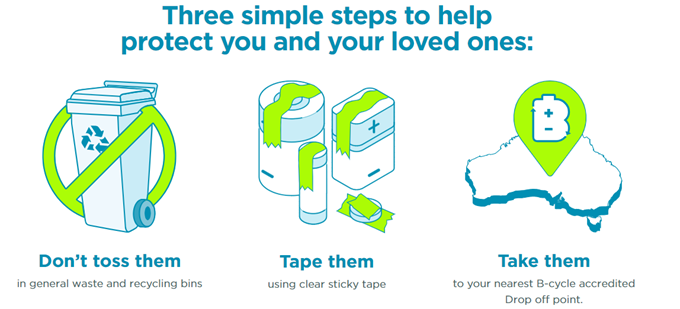
B-cycle is Australia’s official battery recycling scheme supported by the Commonwealth and all State and Territory Governments.
Do you want to know more about B-cycle?
Find a B-cycle Drop off point.
Information on electrical and electronic equipment:
Electronic waste (e-waste) is any waste item that uses a plug, battery or power cord such as, TVs, mobile phones and computers. E-waste can cause serious environmental problems due to toxic chemicals such as lead, mercury and arsenic that pollute our soil and water and disrupt our ecosystems and our health.

Most electrical and electronic products carry the symbol of a crossed-out wheelie bin since 2005 to visibly indicate resource efficiency and environmental protection.
It's illegal for e-waste to enter landfill in many states of Australia.
Australia has a free national recycling scheme for computers which accepts monitors, laptops, keyboards, computer mice, printers, scanners, webcams, computer cables, chargers, hard drives, and motherboards. You can take your e-waste to a suitable collection point operated by dealers or municipalities within your state. Go to your local government website or state authority for details.